

At Tea, every collection begins with curiosity—and often, a new friendship. On our journey through South Korea, we met Seoul-based artist Saerok Won at a cozy neighborhood café, where her playful food-inspired posters caught our eye (and our hearts). What started as a serendipitous moment over dinner turned into a joyful collaboration built on shared stories, laughter, and creativity. In this interview, Saerok shares the inspiration behind her whimsical designs for our latest collection—plus memories of childhood treats, favorite Korean games, and what it means to see her art come to life on kids around the world.
Can you tell us a little about yourself and your art style? What kinds of things inspire your work?
Hi! I’m Saerok, a freelance graphic designer based in Seoul. I’ve been working in design for over 10 years, and a few years ago I started creating illustrations—first for a friend’s wine bar event, and now as a regular part of my work. I wouldn’t say I have a fixed style yet, but I always try to tell a story within a single image. My parents are both writers, so I grew up surrounded by picture books, which I think still influences me today.
Margie Tan, our Fashion Director, was introduced to your artwork while visiting a café in Seoul—can you share what it was like to be approached for a collaboration with Tea?
I still remember that evening clearly. I was having dinner when I heard that someone had asked about my artwork—my posters were all over the walls of that wine bar! That’s how I ended up connecting with Margie, and I was so happy. I’ve always loved kids (I’m the kind of aunt who can play with them all day!), so the idea of my illustrations being printed on t-shirts felt incredibly joyful.
Your designs for this collection are both playful and delicious! Can you walk us through the inspiration behind each of the four food-animal prints?
All four foods are so familiar to me as a Korean that the ideas came very naturally.
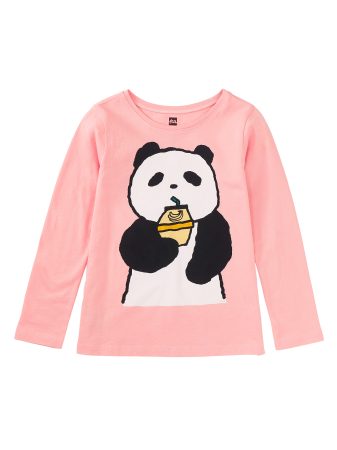
The banana milk panda was inspired by childhood memories—after going to the public bathhouse with my mom, we always had cold banana milk on the way home. That feeling of comfort became the relaxed panda.
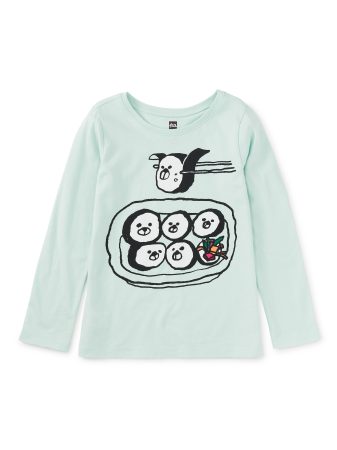
The gimbap puppy might not look exactly like a real gimbap, but I had to include the end piece! In Korea, we call it the “gimbap tail” (꼬다리, kkodari), and it’s often the tastiest part.
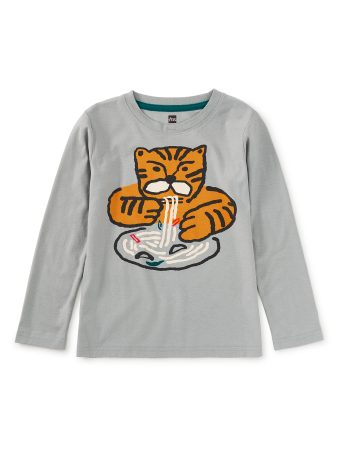
For the japchae tiger, I looked at expressions in Korean folk paintings. What I love is that the tigers in those paintings are rarely scary—they often look curious or friendly.
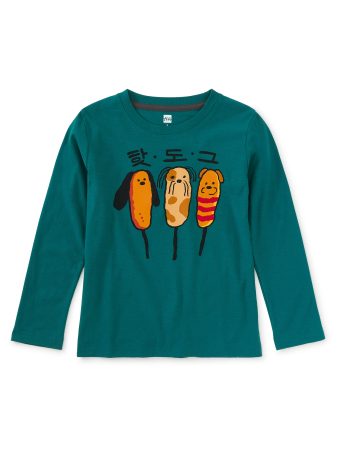
And the hot dog dog was just fun. I laughed a lot while drawing them—with sugar or ketchup on top, they looked like they were enjoying themselves.
Humor, food, and character are such a fun mix in your work. How do you usually approach bringing those elements together?
I usually start with something funny or familiar from everyday life—like food that reminds me of childhood, or a silly personality I imagine for a character. I think I’m just drawing scenes and elements from daily life. But rather than showing a frozen moment, I try to suggest a story behind it—like there’s an invisible “play” button, and if you press it, the scene would keep unfolding.
What was your favorite Korean snack or treat when you were a kid? Are there any childhood games or traditions you remember that are especially unique to Korea?
When I was little, both of my parents worked, so I spent most of my time at my grandparents’ house. I think that’s why I didn’t really have a typical “kid” palate—I liked doenjang stew more than snacks!
What I remember most are the seasonal treats my grandmother used to make. In the spring, she would pick azalea flowers and make hwajeon (화전) — “hwa” means flower, and “jeon” means pancake. It’s a simple rice pancake with blossoms pressed on top. The base was plain and slightly chewy, like rice cake, and she’d grill it and serve it with sugar. It was so pretty and delicious—I still remember how happy I felt eating it.
We used to play a lot of rubber band games in school. Two kids would hold the ends of a long rubber band loop around their legs while crouching down, and another kid would jump in and out of the band while singing a full song without making a mistake.
If you got it right, you moved up to the next level—where the kids holding the band would stand taller, raising the height. Each song had its own specific steps, and some were harder than others.
All we needed was a rubber band and a few friends, and we could play for hours—especially during lunch or recess. (Sometimes the mischievous boys would sneak in with scissors and cut the band just to mess with us!)
Your artwork is now being worn by kids around the world—what’s that like for you? Does it change how you think about connection through art or creativity?
It still doesn’t feel real. It’s such a meaningful thing for me. I’m really happy that I could draw something related to my own country. There are still many parts of Korean culture that people don’t know well, and I try to share them through my drawings. It feels important to show and share something that looks and feels familiar to us.
